
24September 2026
I’m a residential handyman working across downtown Toronto and the GTA. I’m not a specialty fence contractor. I’m the person homeowners call when something on the property needs fixing, and steel fences come up more than you’d expect, especially in older neighbourhoods where the original wrought iron and tubular steel was installed decades ago and has been quietly failing under the surface.
Over the years, I’ve done hundreds of residential jobs across Toronto, Mississauga, Oakville, and Brampton. That volume has taught me something that doesn’t show up in most online cost guides: the visible damage on a steel fence is almost never the whole story. What you see from the sidewalk is the symptom. The cost is in what’s underneath, what’s rusted through at the base, and how long you waited before calling someone.
This post uses real jobs I’ve done in the GTA, real prices I’m quoting right now, and a decision framework I actually use when I’m standing in front of a homeowner’s fence trying to figure out whether to repair or replace. No national averages. No “it depends” without a follow-up. Just what I’ve seen, what I charge, and what I’d tell you if you asked me to look at your fence.
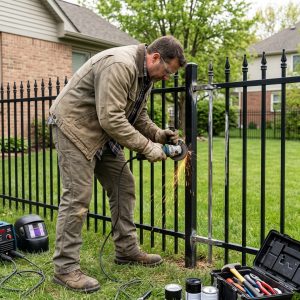
What Steel Fence Repair Actually Costs in Toronto in 2026
These are the ranges I’m working with on residential jobs across the GTA right now. They include labour and materials, assume standard access (no extreme height, no major demolition, no complex site restrictions), and reflect Toronto labour rates, which run higher than most of Canada.
If your quote comes in well below these ranges for a comparable scope of work, I’d ask a few pointed questions about what’s included. Steel work is time-intensive in a way that doesn’t show up in the final photo. The prep, the grinding, the cooling time between welds, the priming, the painting, the alignment checks. All of that is hours, and all of that is in the price.
Spot Rust Repair and Repaint
Grinding back to sound metal, treating the rust, feathering the edges, priming with a metal primer, and applying a compatible topcoat. This is for limited areas, a single panel, or a small section where the structure is sound and only the coating and surface metal are compromised.
Roughly $250 to $600, depending on size, number of panels, and how much prep is needed.
Weld Repair on Pickets, Rails, or Hinge Mounts
Cutting out corroded sections, welding in new steel, grinding the welds smooth, treating any exposed rust, priming, and painting. This is for structural damage at weld points, cracked hinge plates, or sections where the metal has actually corroded through.
Often $400 to $1,200 or more, heavily dependent on how many welds are involved, accessibility, and whether ladders or scaffolding are needed.
Replacing a Steel Post
Cutting the post free, welding in a new section or full post, resetting it in the existing footing (if the footing is sound), grinding, priming, and painting. If there’s masonry work or complex alignment, the price goes up.
Commonly $600 to $1,500 per post.
Post Base or Footing Repair or Replacement
Excavating around the post, breaking out the old concrete footing, cutting off the corroded lower section of the post, welding in a new stub, pouring a fresh concrete footing, realigning the post, then finishing the surface work. This is the job that surprises homeowners the most, because from the outside it looks like “the fence is leaning a bit” and the real work is underground.
Frequently $800 to $2,500 or more per post, especially if there’s interlock, decking, or landscaping to cut through and restore afterward.
Gate Hinge, Latch, and Hardware Replacement
New hinges, latches, possibly self-closing mechanisms, alignment work, and paint touch-up on the affected areas. The range depends on gate size and weight, whether custom fabrication is needed, and how much the hinge mounting areas have deteriorated.
Typically $300 to $900.
Full Panel Replacement
Fabricating a new panel to match the existing profile, removing the old panel, welding and fitting the new one, then doing the full surface prep and finish work on the affected bay.
Often $1,000 to $3,000 or more per panel, depending on height, design complexity, and finish.
Full Fence Replacement (for context)
A full steel fence replacement for a typical residential property in the GTA runs roughly $8,000 to $15,000 or more, depending on length, height, design, and site access. I mention this because it’s the number you need in your head when I talk about the repair-versus-replace decision later in this post.
The Failure Modes Homeowners Don’t See Coming
Most of the steel fence work I get called out for falls into a few categories. The first three are straightforward. The last two are the ones that turn a “small fix” call into a multi-hour job on site.
Rust at Weld Points and Post Bases
This is the big one. Welds where pickets meet rails, and where rails meet posts, trap moisture and start rusting from the inside out. Post bases where the steel meets the concrete footing are constant trouble spots, especially in older properties where water pools or snow and ice sits against the base all winter.
Homeowners often notice surface rust on a panel and call it a paint job. The real issue is almost always at the welds or the base, where the corrosion has weakened the structure and the visible rust on the surface is just the part that’s finally breaking through.
Loose or Rusted-Through Brackets and Fasteners
Very common on older wrought iron and tubular steel fences. Brackets that attach rails to posts or walls loosen as the fasteners corrode. In many cases the bolts or screws are so rusted they snap when you try to remove them, which means drilling out and re-tapping or using new anchor points.
On wall-mounted railings or fences, you often find the steel is fine but the anchors in the brick or concrete have failed, or the masonry around them has crumbled.
Bent or Broken Pickets and Bars
Less common than rust, but not rare. Impact damage from cars backing into driveway gates, kids climbing, bikes hitting panels, or snowplows nicking low sections. In some cases a single bent bar is cosmetic. In others, the impact has distorted the rail or post enough to affect alignment and gate operation.
Depending on severity, this is either straightening and repainting, or cutting out and rewelding a new picket or section.
Footing Failure Disguised as Fence Failure
This is the one that catches people off guard. The steel looks okay above grade, but the concrete footing has cracked or heaved, letting the post rotate or sink. Homeowners expect a simple weld or bracket fix. The real job involves excavating, resetting or replacing the footing, then aligning the post.
In Toronto’s clay soil, this is more common than you’d think. The clay holds moisture against the post base through every freeze-thaw cycle, and if the original footing was set shallow or poorly, it will heave over time.
Rust Hidden Under Paint or Powder Coat
A small blister or chip on the coating turns out to be widespread corrosion once you start grinding. What looked like a spot repair becomes “replace this whole panel” or “reset these posts.” This is especially common on powder-coated fences that homeowners assume are maintenance-free.
The coating is a barrier, not a cure. Once it’s compromised, the steel underneath starts corroding, and it does so faster than the visible damage would suggest. By the time the rust is breaking through the paint, it’s already spread underneath.
Three Real Jobs from the GTA
These are three jobs I’ve done that illustrate the pattern I see over and over: the homeowner describes a small problem, the inspection reveals a structural one, and the cost reflects the real scope of work, not the perceived one.
Junction Townhouse: “The Gate Sticks a Bit”
The homeowner told me the gate looked a bit rusty near the bottom and it stuck when they tried to close it. They were hoping I could clean it up and maybe lubricate the hinges.
What I found: Surface rust on the lower pickets, yes, but the real issue was at the hinge-side post base. The steel post was sound above grade, but where it met the concrete footing, the metal had corroded through on two sides. Every time the gate swung, the post flexed slightly in the footing. That movement had cracked the welds on the top hinge plate, which is why the gate was binding and sagging.
The repair: Cut the gate free and supported it on blocks. Excavated around the post base, broke out the old concrete footing, cut off the corroded lower section of the post, welded in a new steel stub, set a fresh concrete footing, and realigned the post so the gate hung true. Reground and rewelded the cracked hinge plate, installed new hinge pins, adjusted the latch, then primed and painted the repaired areas to match.
On site for most of a day, roughly 6 to 7 hours of labour.
Final cost: Around $1,900 all in.
The lesson: Six to twelve months earlier, this could have been a $300 to $500 job. Grind, treat the rust, repaint, maybe tweak the hinges. By the time I got there, the footing and post base were gone, and the cheap fix was no longer an option. If a steel gate is sticking and you see rust at the base, don’t wait. Once the footing starts to fail, the price jumps into the four figures fast.
Etobicoke Driveway: “The Fence Leans a Little Where the Car Backs In”
The homeowner told me the fence looked like it was leaning where the car backs in. They thought one of the panels got hit last winter and asked if I could straighten it and tighten things up.
What I found: A six-foot section of tubular steel fence along the driveway was visibly out of plumb. The impact had bent two pickets and distorted the lower rail, but the bigger issue was the corner post. The base had rotated in the footing, and the concrete itself was cracked. The powder coat was flaking around the impact zone, and once I started grinding, I found rust spreading from the welds where the rail met the post. Moisture had been getting in since the hit, and Toronto winters had done the rest.
The repair: Removed the damaged panel section, cut out the bent pickets and lower rail, fabricated and welded in a new rail segment and two new pickets matching the existing profile. Cut the post free at the base, broke out the cracked footing, reset the post with new concrete, and realigned the whole section. Ground all welds smooth, treated rust, primed, and painted the entire repaired bay so it didn’t look patchy.
On site for about 5 to 6 hours.
Final cost: Roughly $2,200 for the section.
The lesson: If the homeowner had called someone right after the impact, they likely could have gotten away with $600 to $900. Straighten or replace the bent pickets, touch up the coating, maybe reinforce the rail. Waiting let water in, rust spread, and the footing deteriorate from the repeated stress of the car backing in. With steel fences, impact damage plus Toronto winters almost always means deal with it now or pay double later.
Liberty Village Townhome Complex: “The Powder Coat Is Peeling, Can You Just Sand and Repaint?”
The homeowner told me the powder coating was peeling in spots and there was some rust coming through. They were hoping I could sand it and repaint those areas so it looked decent again.
What I found: Multiple panels with flaking powder coat, especially along welds and at the base of pickets. Where the coating had lifted, rust was already undercutting the paint over fairly large areas, much bigger than the visible blisters. Several bracket fasteners were heavily corroded. A couple snapped when I tried to loosen them, revealing that the holes in the posts were elongated from movement.
In several bays, the corrosion was structural enough that spot repairs wouldn’t last.
The repair: On the worst two panels, cut out the corroded lower sections of pickets and part of the bottom rail, welded in new steel, and reattached with new stainless fasteners. On the remaining panels, stripped all loose coating, ground back to sound metal, treated rust, primed with a metal primer, and applied a durable topcoat system. Replaced all corroded brackets and fasteners in the affected run, tightened everything, and checked alignment.
This was a two-visit job. One day for the heavy fabrication, a second shorter visit to finish prep and painting once everything had cooled and settled. Total on-site time around 8 to 9 hours.
Final cost: About $2,600 for the run of fence.
The lesson: Homeowners often assume powder coat is maintenance-free. In Toronto, once it starts failing at welds or scratches, rust spreads underneath faster than it looks from the outside. A proper repair isn’t just sand and spray. It’s stripping, treating, priming, and repainting with the right products, plus replacing any fasteners that have corroded. If you catch it early, you might spend $400 to $700 on a couple of panels. Let it go until the coating is blistering everywhere, and you’re quickly into the $2,000 or more range.
Three Things I Tell Homeowners That Go Against the Grain
Painting Over Rust Without Proper Prep Is Worse Than Doing Nothing
Most online content tells homeowners: see rust, sand it a bit, hit it with a rust converter from the hardware store, then paint. In Toronto, that advice is how you turn a manageable repair into a recurring headache.
Painting over rust without grinding back to sound metal traps moisture, gives a false sense of security, and guarantees the rust will come back under the new paint, often worse. Bottle-of-converter fixes are mostly cosmetic. They can help in very small, early-stage spots, but they’re not a substitute for proper prep: grinding, feathering edges, treating, priming with a proper metal primer, then topcoating.
The jobs that come back to haunt people are the ones where you can see a patch of fresh paint over a rusty area. Six to twelve months later, that patch is blistering, and the corrosion has spread beyond the original spot.
If I’m quoting a steel fence and I see half-done paint-over jobs from a previous attempt, I tell the homeowner upfront: we’re either doing this properly, strip, treat, prime, paint, or we’re wasting your money. There’s no reliable middle ground.
Powder Coat Is Not Maintenance-Free. It’s Maintenance Delayed.
There’s a widespread assumption that powder-coated steel fences don’t need anything until they look terrible. That’s dangerously wrong in our climate.
Powder coat is tougher than standard paint, but once it’s scratched, chipped, or compromised at a weld, Toronto’s freeze-thaw cycles and road salt turn that small defect into a rust factory. The first sign of trouble is usually tiny: a small chip near a gate latch, a scratch where a bike leaned on the fence, a hairline crack at a weld. Homeowners ignore it because it’s powder-coated. By the time they call someone, the rust has undercut the coating over a much larger area.
What “maintenance-free” actually means is: you won’t notice it failing until it’s expensive. A fence that gets a quick annual look-over, with chips touched up properly, can last decades. A neglected powder-coated fence in Toronto often hits a tipping point where whole panels need stripping, welding, and refinishing, or replacement.
Plan on inspecting your powder-coated fence once a year and fixing small damage immediately. If you treat it as zero-maintenance, you’re signing up for a four-figure repair sooner than you think.
Once Multiple Posts Are Failing, It’s a Replacement Decision, Not a Repair Job
This is where my view probably contradicts a lot of generic how-to-repair articles. They’ll walk you through fixing one post, then another, then another, without ever asking: why are so many posts failing?
My rule of thumb:
- One isolated post or bracket issue in an otherwise solid run? That’s usually a legitimate repair. Maybe a car clipped it, maybe a single footing was poorly done. Fix it properly, address the cause, and the rest of the fence can go another 10 to 15 years.
- Two posts with base corrosion in the same run? Now I’m suspicious. I start asking: is this age, soil, installation quality, or chronic water exposure? If the rest of the fence is in good shape, I might still recommend targeted repairs, but I’ll warn the homeowner that more posts could follow.
- Three or more posts with base or footing failure in one run? At that point, I almost always recommend replacement, not repair. You’re no longer fixing an isolated problem. You’re fighting the overall condition of the fence. Spending $1,500 to $2,000 per post on multiple posts quickly approaches the cost of a new, properly installed steel fence that’ll last decades.
I’ve seen too many homeowners spend $1,500 or $2,000 fixing one post, then another $1,800 on the next, and by the time they get to the third, they’ve spent more than a new fence would have cost, and they still have an aging, rust-prone structure. The repair route only makes sense when the rest of the fence is truly sound and the problem is clearly isolated.
Repair or Replace? Use This Checklist
When I’m standing in front of a homeowner’s steel fence and they’re asking me whether to fix it or replace it, here’s the checklist I run through. You can use it yourself.
How Many Posts Show Base Corrosion, Movement, or Footing Issues?
- One post: repair is usually sensible.
- Two posts: possible repair, but inspect the whole run carefully and ask why both are failing.
- Three or more posts in one run: strongly consider replacement.
Is the Rust Mostly Surface-Level, or Is It Structural?
- Surface rust on small areas, coating otherwise intact: repair and refinish.
- Rust through pickets, rails, or post bases, widespread blistering: lean toward replacement.
What’s the Approximate Age and Overall Condition?
- Under about 10 to 15 years, otherwise solid: repair is usually worth it.
- 15 to 20 or more years, with visible wear in multiple areas: replacement often makes more sense.
What’s the Repair Quote Versus the Replacement Quote?
- Repair under about 40% of replacement, and the rest of the fence is solid: repair.
- Repair at 50% to 70% of replacement, with questionable remaining life: think hard. Ask yourself how many good years you’ll actually get out of it.
- Repair at 70% or more of replacement on an aging fence: replacement is probably the smarter move.
Is This Something You Can Safely DIY?
- Small hardware swaps, minor cosmetic rust on a few square inches, simple gate adjustments: a competent DIYer can handle it.
- Posts, footings, welding, major rust damage, heavy gates: call a pro.
The key question I ask every homeowner, and the one I’d ask you to ask yourself: if you spend this much on repairs, how many good years do you actually get out of it? If the answer is “maybe three to five years before something else fails,” that’s a bad investment, no matter how cheap the repair quote looks compared to a full replacement.
DIY or Call a Pro? Where I Draw the Line
I’m not anti-DIY, but steel fences are less forgiving than wood. Here’s where I draw the line.
What a Competent DIYer Can Reasonably Handle
- Replacing a latch, handle, or self-closer on a gate.
- Tightening or replacing accessible bolts and brackets, as long as they’re not heavily corroded or structural.
- Light surface rust on a small area, properly prepped: wire brush or sandpaper, rust converter, metal primer, paint. This is only for truly cosmetic, small areas. Think a few square inches, not whole panels.
- Adjusting hinge positions or strike plates if the gate is slightly misaligned but still structurally sound.
Even with these, a few conditions: call before you dig if there’s any chance you’ll be near buried utilities. Use proper PPE, gloves and eye protection, when grinding or drilling metal. Don’t attempt anything that affects structural integrity.
What Should Always Be a Pro Job
- Any post or footing work: digging out and resetting steel posts, cutting and welding new post sections, breaking out and replacing concrete footings. This is heavy, structural work that affects the entire fence’s stability.
- Welding repairs: rewelding pickets, rails, hinge plates, or brackets, especially on load-bearing or gate components. This requires proper equipment, skill, and an understanding of how heat affects the surrounding coating and structure.
- Large-scale rust repair where structure is involved: if rust has eaten through pickets, rails, or post bases, if you’re cutting out sections and fabricating new pieces, or if the coating failure is widespread and you’re effectively refinishing most of the fence.
- Anything involving tall or heavy gates: large steel gates can be dangerously heavy and under tension. Misjudging support during hinge or post work can lead to injury or property damage.
My blunt summary: cosmetic, small, non-structural? A careful, competent DIYer can handle it. Anything structural, welded, or involving posts or footings? That’s a pro job, every time.
Bottom Line
Steel fence repair in Toronto in 2026 costs more than most homeowners expect, and the reason is that the visible damage is rarely the whole job. The cost is in the prep, the structural work underneath, and the time it takes to do it properly so it actually lasts.
A small rust spot that gets caught early is a $250 to $600 job. The same rust spot left for a year, once it’s reached the post base and the footing is cracking, is a $1,500 to $2,500 job. That’s not a pricing markup. That’s the difference between sanding and painting, and excavating, welding, pouring concrete, and repainting.
If your steel fence is showing rust at the base, sticking gates, leaning sections, or peeling powder coat, the most cost-effective thing you can do is get it looked at now, not after the next winter. And if you’re getting a quote, use the ranges in this post to check whether it’s in the right zone. A quote that’s dramatically low for a comparable scope is a red flag. A quote that’s dramatically high is worth a second opinion.
And if your fence is past the point where repair makes sense, a pro should tell you that directly, not keep selling you one more post replacement.
One Reply to “Steel Fence Repair Costs: What You Should Expect to Pay in 2026”