
12July 2026
IKEA Furniture Assembly: Hiring Help vs. DIY
My IKEA Assembly Origin Story
My IKEA assembly story started the same way it does for a lot of handymen: helping friends and family who got halfway through a project and realized it wasn’t as straightforward as it looked in the showroom. The first IKEA pieces I assembled were basic items, a couple of bookshelves, a TV stand, and a bed frame. At the time, I thought, “How hard can it be?” Then I learned that success with IKEA furniture is all about organization, patience, and following the instructions in the right order.
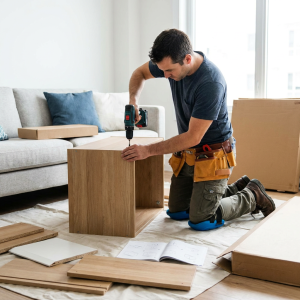
One of my early wins was assembling a large PAX wardrobe system for a client. It involved multiple frames, drawers, shelves, and sliding doors. It took careful planning, measuring, and leveling, but when everything lined up perfectly and the doors glided smoothly, it was incredibly satisfying. That project showed me how well‑designed IKEA products can be when they’re assembled correctly.
Of course, there were disasters too. I remember an early project where someone had already started assembling a dresser before calling me. Several panels were installed backward, a few cam locks were damaged from over‑tightening, and some hardware was missing. We ended up disassembling most of it and starting over. That experience taught me that fixing a partially assembled piece often takes longer than building it correctly from the beginning.
Those experiences have shaped my view on DIY versus hiring help. Many IKEA items are absolutely manageable for people who enjoy hands‑on projects, have the right tools, and can dedicate the time to following instructions carefully. DIY can save money and give a sense of accomplishment. On the other hand, larger wardrobes, wall‑mounted systems, bunk beds, entertainment centers, and multi‑room setups can quickly become time‑consuming and frustrating, especially if precision matters.
Who Actually Succeeds With DIY (And Who Doesn’t)
After helping friends, family members, and paying clients with IKEA assembly over the years, I’ve noticed some very consistent patterns. The people who tend to succeed with DIY assembly are usually patient, organized, and willing to take their time. They lay out all the parts, carefully follow the instructions, and don’t rush through the process. They don’t necessarily have advanced handyman skills, they’re just methodical and comfortable solving small problems as they come up.
The people who most often end up needing help are usually short on time, trying to assemble large or complex pieces by themselves, or assuming the project will be much easier than it actually is. Problems often start when someone skips steps, doesn’t verify measurements, or starts forcing parts together when something doesn’t fit correctly. Once a mistake happens early in the process, it can create a chain reaction that’s difficult to fix later.
A DIY Success Story
One example that stands out was a client who purchased a large PAX wardrobe system. Before starting, they spent time reading the instructions, organized every hardware packet, and cleared a large workspace. They completed most of the assembly themselves and only brought me in to help secure the units and align the doors. The project went smoothly because they approached it patiently and treated it like a step‑by‑step process rather than a race to the finish line.
When DIY Turns Into a Rescue Job
On the other hand, I once helped a customer with a dresser that had already been partially assembled before I arrived. Several panels were installed backward, drawers were built incorrectly, and some of the hardware had been over‑tightened and damaged. The customer admitted they had skimmed the instructions and tried to “figure it out as they went.” What should have been a couple of hours of assembly turned into a much longer job because we had to carefully disassemble and rebuild much of the unit from scratch.
Those experiences have reinforced my belief that DIY success is usually less about technical skill and more about patience, attention to detail, and having enough time to do the job properly. People who enjoy that process often do very well on their own. People who are rushed, frustrated, or tackling a large project without preparation are the ones who most often benefit from bringing in help.
The True Cost of IKEA Assembly in the GTA
From my perspective as someone working in the GTA, the true cost of IKEA assembly goes far beyond the assembly fee itself. Most people naturally compare the price of hiring help against doing it themselves, but they often overlook the value of their own time, the stress involved, the risk of mistakes, and the long‑term durability of the finished product.
For a simple bookshelf or side table, DIY is usually the better value. Spending an hour or two assembling a straightforward piece can save money, and most people can handle it without much trouble. Where the calculation changes is with larger projects such as PAX wardrobes, wall‑mounted storage systems, bunk beds, entertainment centers, or multiple‑room furniture packages. Those jobs can easily consume an entire weekend for someone without experience.
The Hidden Cost of Mistakes
One factor many people underestimate is the cost of mistakes. A damaged panel, stripped fastener, misaligned drawer, or incorrectly installed door can sometimes require replacement parts, additional trips to IKEA, or complete disassembly and rebuilding. I’ve seen situations where a customer spent six or seven frustrating hours on a project, only to call for help anyway. At that point, they effectively paid twice, once with their time and again with a service fee.
Safety and Long‑Term Reliability
Safety is another important consideration. Large wardrobes, tall bookcases, and wall‑mounted systems need to be assembled and secured properly. In homes with children or pets, proper anchoring isn’t just a convenience, it’s a safety issue. A furniture tip‑over accident can be far more costly than the price of professional assembly.
One example where hiring help clearly saved money involved a client who purchased several PAX wardrobe units for a master bedroom. The installation required careful measuring, leveling on uneven floors, door alignment, and wall anchoring. Had mistakes been made during assembly or installation, replacement components and lost time would have added up quickly. The project was completed correctly in a single visit, and the client avoided what likely would have been an entire weekend of trial and error.
On the other hand, I’ve also seen cases where hiring help probably wasn’t worth it. A customer once hired me to assemble a very basic nightstand and a small end table that came with clear instructions and relatively few parts. The work was completed quickly, but I remember thinking that someone with a free evening and a screwdriver could have comfortably handled it themselves. In that situation, the convenience was nice, but it wasn’t necessarily the most economical choice.
My rule of thumb is simple: if the project is small, low‑risk, and you enjoy DIY work, assembling it yourself often makes perfect sense. If the project is large, complicated, safety‑sensitive, or likely to consume an entire day of your time, hiring professional help often provides better overall value—even if the upfront cost is higher. When you account for time, stress, potential mistakes, and long‑term reliability, the cheapest option on paper isn’t always the least expensive option in practice.
My IKEA DIY vs Hire Help Checklist
Over time, I’ve developed a simple set of decision rules that I use when people ask whether they should assemble IKEA furniture themselves or hire help. If I answer “yes” to most of the DIY questions, I usually encourage them to do it themselves. If I answer “no” to several of them, I recommend hiring help.
Rule #1: Can You Realistically Dedicate Uninterrupted Time?
DIY if:
-
You have enough free time to complete the project without rushing.
-
You’re comfortable spending several hours on assembly if needed.
Hire help if:
-
You’re trying to squeeze the project into a busy evening.
-
You need the furniture finished quickly.
-
Losing half a weekend would be frustrating.
My rule: If you’re already worried about how long it will take, it will probably take longer than you think.
Rule #2: Is the Furniture Large, Heavy, or Difficult to Move?
DIY if:
-
One or two people can safely handle the parts.
-
The item is relatively compact and easy to reposition.
Hire help if:
-
It’s a large PAX wardrobe, bunk bed, entertainment center, or wall system.
-
The assembled unit may be difficult to move through doors or hallways.
-
You’ll be lifting heavy panels alone.
My rule: The bigger the box, the less the project is about assembly and the more it’s about logistics.
Rule #3: Are Mistakes Inexpensive to Fix?
DIY if:
-
A mistake would be easy to undo.
-
The project has relatively few parts.
Hire help if:
-
Incorrect assembly could damage expensive components.
-
The project includes multiple drawers, sliding doors, custom layouts, or complicated hardware.
My rule: If rebuilding it would make you angry, consider hiring help before you start.
Rule #4: Does the Project Involve Safety or Wall Anchoring?
DIY if:
-
You’re comfortable using tools, locating studs, and following anchoring instructions.
Hire help if:
-
The furniture must be secured to the wall.
-
Children or pets will be around the furniture.
-
You’re unsure about mounting, leveling, or anchoring.
My rule: Never treat wall anchoring as an optional step.
Rule #5: Do You Actually Enjoy Assembly Work?
DIY if:
-
You enjoy following instructions and solving small problems.
-
You find assembly satisfying rather than stressful.
Hire help if:
-
Furniture assembly feels like a chore.
-
You become frustrated when things don’t go perfectly.
-
You know you’ll be stressed before opening the box.
My rule: The people who enjoy the process usually succeed. The people who dread the process usually regret not hiring help sooner.
The Final Test
If you answer “YES” to all three questions below, DIY is probably the right choice:
-
I have enough time.
-
I can safely handle the size and weight.
-
I’m comfortable fixing mistakes if they happen.
If you answer “NO” to two or more of those questions, hiring professional assembly help will usually save time, stress, and frustration, and may actually be cheaper in the long run.
What My IKEA Distribution Center Experience Taught Me
One thing that gives me a different perspective from many handymen is that my experience with IKEA didn’t start in customers’ homes—it started behind the scenes at an IKEA distribution center. That experience changed the way I think about IKEA furniture, assembly, and the true risks involved in DIY projects.
Most people only see IKEA products once they arrive at the store or at their front door. I had the opportunity to see what happens before that. I saw how products are packaged, stacked, moved through warehouses, loaded onto trucks, unloaded, and transported through multiple stages before reaching the customer. That gave me a much better understanding of why certain components are designed the way they are and where damage is most likely to occur.
For example, many customers assume that if a box looks fine on the outside, everything inside must be perfect. In reality, furniture can experience a surprising amount of handling throughout the supply chain. While IKEA’s packaging is generally efficient, corners, edges, hardware packets, and thinner panels are naturally the most vulnerable areas. Because of that experience, one of the first things I do before assembly is inspect critical components rather than immediately starting the build.
Working in logistics also taught me that flat‑pack furniture is designed around transportation efficiency as much as assembly convenience. Many pieces are engineered to fit specific package dimensions, maximize truck space, and reduce shipping costs. As a result, some assemblies involve more individual parts and connection points than traditional preassembled furniture. A casual DIYer may see a large pile of hardware and wonder why the design is so complex, but understanding the logistics side helps explain why IKEA products are engineered that way.
Another insight is that I’ve seen firsthand how much variation exists between different IKEA products. Not all assemblies are created equal. Some items are intentionally designed for quick, beginner‑friendly assembly, while others—particularly large wardrobes, storage systems, and modular furniture—can become surprisingly complex. Because I’ve seen both the logistics side and the installation side, I can often tell from the packaging, component count, and product design whether a project is likely to be a straightforward afternoon build or a much larger undertaking.
This background also affects how I think about hiring help. Many people assume the challenge begins when the instructions are opened, but in reality the process starts much earlier. Transporting multiple heavy boxes into a home, carrying them upstairs, organizing components, identifying damage, and creating enough workspace can be just as challenging as the assembly itself. Those are factors that a typical DIYer may not fully consider when deciding whether to tackle a project alone.
Perhaps the biggest lesson I took from working in the distribution environment is that successful assembly isn’t just about turning screws. It’s about understanding the entire journey of the product, from warehouse shelf to finished furniture. Having seen that full process, I tend to evaluate projects differently than someone who only sees the final instruction manual. It helps me spot potential issues earlier, recognize when a project carries a higher risk of damage or frustration, and make better recommendations about when DIY makes sense and when professional help is likely to provide better value.
That combination of logistics experience and hands‑on assembly work has given me a broader perspective than either role would have provided on its own. I’ve seen what happens before the box reaches the customer, and I’ve seen what happens after it’s opened. Together, those experiences have shaped how I approach every IKEA project and how I advise others on whether to build it themselves or bring in help.
DIY or Hire Help? My Honest Advice
If you enjoy hands‑on work, have the time, and your project is relatively simple, DIY IKEA assembly can be a satisfying and cost‑effective choice. You’ll learn a lot, gain confidence, and have a real sense of accomplishment when you tighten the last screw.
If, however, your project is large, complex, safety‑sensitive, or likely to turn your entire weekend into a stressful puzzle, hiring a handyman is often the smarter move. In many cases, you’re not just paying for assembly—you’re paying to avoid expensive mistakes, protect your home and family, and get furniture that works smoothly for years.
In the end, the best decision isn’t “DIY vs hiring” in general. It’s about being honest with yourself about the specific project in front of you—and using a checklist like the one above before you open the first box.