
17September 2026
If you have a hole in your wall and you’re wondering whether you can just pop into Home Depot, grab a small piece of drywall, and patch it yourself, the honest answer is: it depends. And “it depends” is not a helpful answer when you’re standing in a parking lot in Mississauga at 4 PM on a Saturday.
I’m a professional residential handyman based in the GTA. I’ve been doing drywall repairs, patches, and touch-ups across Toronto, Oakville, Milton, and Brampton for years. I’ve seen the small nail holes that are genuinely a 15-minute DIY job, and I’ve seen the “tiny holes” that turn out to be fire-rated condo walls in a bathroom with orange-peel texture, where a botched patch costs you your deposit.
This post is the guide I wish I could hand to every homeowner who asks me, “Can I just buy a small piece of drywall and fix this myself?”
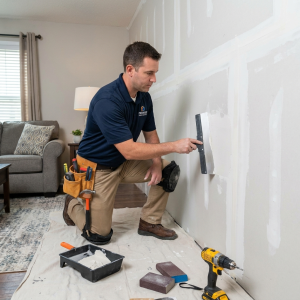
A Real Story: When a “Simple” Patch Cost a Condo Owner Her Deposit
Last winter, I got a call from a condo owner in Liberty Village. Her problem sounded simple: a 6×8 inch hole where a towel bar had ripped out of the bathroom wall. She’d already tried to fix it herself.
What She Tried First
She bought a self-adhesive mesh patch and a tub of lightweight spackle from a big-box store in Etobicoke. She pressed the mesh over the hole, filled it with spackle, sanded it smooth, and painted over it with “bathroom white” from a hardware store near King and Strachan.
Within two weeks, the patch cracked around the edges and the paint bubbled from the humidity. Her property manager warned her she’d lose part of her deposit if the wall wasn’t fixed properly before move-out.
What I Found When I Removed the Failed Repair
When I got to the unit and removed her DIY patch, the real problem became clear:
- The original drywall was 5/8-inch fire-rated, which is standard in Toronto condo bathrooms. Her patch was effectively just a surface cover over a void.
- There was no backing behind the hole. Just insulation and the stud cavity.
- The wall had a light orange-peel spray texture, not a flat sanded finish.
So this wasn’t a “buy a small piece of drywall and screw it in” situation. I had to cut the damaged section back to a neat rectangle, install a backing piece of wood inside the cavity, cut a matching 5/8-inch fire-rated drywall patch, screw it to the backing, tape and mud with setting-type compound, sand, and re-spray the orange-peel texture to blend.
Sourcing the Small Piece Was Its Own Challenge
Here’s where the “small piece of drywall” problem showed up. Big-box stores near downtown, around King Street West, Liberty Village, and Dufferin, mostly stock full 4×8 sheets of 1/2-inch and 5/8-inch drywall. They don’t advertise “we’ll sell you a 12×12 offcut,” and most staff aren’t set up to cut and sell random scraps.
I ended up driving to a smaller supplier near the Gardiner and Dufferin who keeps offcuts from job sites. They sold me a roughly 2×2 foot piece of 5/8-inch fire-rated board for $15, which was perfect.
If I’d tried to buy a full sheet just for an 8×10 inch patch, the client would have been paying over $60 for material, plus the hassle of getting a 4×8 sheet into a downtown condo elevator and then disposing of the leftover.
How It Turned Out
I matched the thickness, taped and mudded the seams, and used a small HVLP sprayer to replicate the orange-peel texture. After priming and painting, the patch was invisible unless you knew exactly where to look.
The client passed her final inspection, got her full deposit back, and later referred two neighbours in the same building for similar touch-ups.
When You Can DIY vs. When to Call a Pro
After years of patching drywall in Toronto condos, townhomes, and detached houses, my rule of thumb is simple: if the repair is only cosmetic and small, a careful homeowner can usually handle it. Once you get into anything that affects fire rating, moisture resistance, texture matching, or structural backing, you’re in “call a pro” territory.
DIY Is Reasonable When All of These Are True
- The hole is up to about 2 to 3 inches, or it’s a hairline crack under 6 to 8 inches that isn’t recurring
- The location is a dry, interior room like a bedroom, hallway, or living room. Not a bathroom, kitchen, garage, or mechanical room
- The wall is standard 1/2-inch residential drywall, not fire-rated or moisture-resistant board
- The finish is flat or lightly rolled paint, with no heavy texture like orange peel, knockdown, or popcorn
- The drywall around the hole is still solid and attached to studs, with no big void behind it
In those cases, a mesh patch and joint compound, or a quality wall repair kit, plus careful sanding and touch-up paint is usually enough. It might not be invisible, but it’ll look acceptable for most homeowners.
Call a Pro When Any of These Apply
- The hole is larger than about 4 to 6 inches. Once you’re past that, you usually need to cut back to a neat shape, add backing, and screw in a new piece of drywall. A surface mesh patch won’t hold.
- The wall is fire-rated or specialty drywall. Many Toronto condo walls, especially around bathrooms, garages, and furnace rooms, use 5/8-inch fire-rated board. Patching with standard 1/2-inch or a surface-only kit compromises the rating and can cause issues with insurance or condo inspections.
- The area is wet or high-humidity. Bathrooms, laundry rooms, and areas near sinks or showers often use green board or moisture-resistant drywall. A generic spackle patch in these zones tends to fail quickly from humidity and condensation.
- The wall has a textured finish. Orange peel, knockdown, or sprayed textures are hard to match without the right tools and technique. Most DIY patches end up as a visible smooth island in a textured wall, which looks worse than the original hole.
- There’s missing backing or a structural concern. If the drywall is crushed, loose, or there’s no solid backing behind the hole, you need to install wood blocking and properly secure a new piece. Recurring cracks, especially over doors, windows, or where walls meet ceilings, can signal framing movement or settlement.
- You need it to pass a property manager inspection, recover a deposit, or satisfy an insurance claim. A shoddy patch can cost you more in the long run.
The Most Common Mistake I See
The most common mistake homeowners make is thinking, “It’s just a hole. I’ll buy a self-adhesive patch and some spackle and it’ll be fine.”
That works for tiny nail holes in a bedroom. It does not work for bathroom walls where humidity will pop the patch, condo walls that must remain fire-rated, anywhere with texture that now has a glaring smooth spot, or holes that actually need backing and proper screwing rather than just a surface cover.
I’ve lost count of how many times I’ve been called to redo a DIY patch that looked okay for a week, then cracked, bubbled, or became more obvious than the original damage. It happens a lot in Liberty Village, King West, and other downtown condo buildings.
Where to Actually Buy a Small Piece of Drywall in the GTA
If you’re reading this while standing in a Home Depot or Rona parking lot in Mississauga, Etobicoke, or downtown Toronto, here’s exactly what I tell people based on years of sourcing drywall for patches and repairs across the GTA.
Big-Box Stores: Home Depot, Rona, and Others
The reality is that these stores primarily sell full 4×8 sheets of drywall. Most locations do not officially sell small offcuts. What you see on the floor is either damaged goods or stuff waiting to be tossed. Some staff will cut a piece for you if you’re buying a full sheet, but they’re not set up to sell you a random 12×12 scrap from the back.
I still use big-box stores when I need a full sheet for a larger repair or multiple patches, or when I want to compare thickness, fire-rated versus standard, and moisture-resistant options side by side.
When I’m there, I ask for specific things:
- “I need 1/2-inch regular drywall for a patch in a bedroom.”
- “This is a bathroom or garage wall. Do you have 5/8-inch fire-rated or green board?”
I always bring a tape measure and, if possible, a small sample or photo of the existing wall edge to match the thickness.
A full 4×8 sheet of 1/2-inch drywall runs roughly $18 to $25 depending on brand and location. They won’t prorate much for a small piece, and if they do sell you an offcut, expect them to charge around $10 to $15 just to make it worth their time.
Smaller Drywall Suppliers and Lumber Yards
These are the places that actually serve contractors. Think suppliers near the Gardiner and Dufferin area, in Etobicoke industrial zones, Mississauga, and Brampton.
They’re my go-to for small pieces because:
- They often have offcuts and remnants from job sites
- They’re more likely to sell you a 2×2 or 2×4 foot piece instead of forcing a full sheet
- Staff usually know the difference between Type X (fire-rated), regular, and green board, and can pull the right thing quickly
What to ask for:
- “Do you sell offcuts or remnants of 5/8-inch fire-rated drywall?”
- “I need a small piece for a condo bathroom patch. It must match 5/8-inch fire-rated.”
- “Can you cut me roughly a 2×2 foot piece from a scrap?”
Be clear about the thickness (1/2-inch versus 5/8-inch), the type (regular, Type X fire-rated, or green/moisture-resistant), and the use (condo wall, garage, bathroom, etc.).
A small offcut, say 2×2 to 2×4 feet, often runs $10 to $25 depending on thickness and supplier. That’s still cheaper than buying a full sheet and hauling and disposing of the rest, especially for downtown condo jobs.
Job-Site Offcuts and Contractor Connections
This is the insider option. If you know a drywall installer, renovation crew, or handyman, ask if they have leftover pieces from recent jobs. Many contractors end up with partial sheets they’d rather sell cheap or give away than haul to the dump.
What to ask:
- “Do you have any leftover 5/8-inch fire-rated or 1/2-inch regular from recent jobs?”
- “I just need a small piece for a patch, not a full sheet.”
Price is often $5 to $15, sometimes free if you’re helping them clear space. This is my go-to when I’m doing multiple small patches in one building.
What to Ask for at the Counter
Most people walk in and say, “I need a piece of drywall.” That’s too vague. I tell them to be specific:
- “I need a 12×12 or 18×18 piece of 1/2-inch regular drywall for a bedroom patch.”
- “This is a condo bathroom wall. I need 5/8-inch fire-rated.”
- “Can you cut me a small piece from a scrap or offcut? I don’t need a full 4×8.”
If you have a piece of the old wall, bring it with you and say, “Can you match the thickness and type?” That one step avoids most thickness and fire-rating mistakes.
Realistic Prices for a Small Piece in the GTA
Here are rough guidelines based on what I see:
- Big-box store offcut (if they agree to cut one): $10 to $15
- Small supplier offcut (2×2 to 2×4 feet): $10 to $25
- Full 4×8 sheet of 1/2-inch regular: roughly $18 to $25
- Full 4×8 sheet of 5/8-inch fire-rated: roughly $25 to $35 or more
- Contractor or job-site scrap: $5 to $15, sometimes free
Remember: if you buy a full sheet, you’re also paying in time and hassle to get it into your vehicle, get it up or down elevators or stairs, cut it down, and dispose of the leftover. Many condo buildings charge for disposal.
Common Gotchas When Buying “Just a Small Piece”
These are the mistakes I see all the time:
- Thickness confusion. Most interior walls in older homes use 1/2-inch drywall. Many Toronto condo walls, especially around bathrooms and garages, use 5/8-inch fire-rated. Patching a 5/8-inch wall with 1/2-inch creates a recessed patch that’s almost impossible to hide.
- Fire-rated versus standard. Type X (fire-rated) is often required by code in certain walls. Using regular drywall in those spots can cause issues with condo inspections and insurance.
- Asking the wrong question. “Do you have drywall?” gets you pointed at full sheets. Better to ask, “Do you have offcuts or remnants of 5/8-inch fire-rated board? I only need a small piece for a patch.”
- Ignoring moisture-resistant board in wet areas. Bathrooms and laundry areas often use green board or specific moisture-resistant products. Regular drywall patches in these areas tend to fail faster.
Pre-Cut Patch Panels vs. Cutting Your Own
You’ll see small pre-made patch kits or drywall repair panels in big-box stores. Self-adhesive metal or plastic-backed squares with some compound.
My honest take: they’re fine for very small holes, nail holes or 1 to 2 inch dings in low-visibility areas. They’re not great for anything over about 3 inches, textured walls, or fire-rated or moisture-prone areas.
I usually cut my own because I can match the exact thickness and type (regular, fire-rated, or green board), shape the patch to fit neatly between studs or around obstacles, and get a finish that’s more durable and blendable than most stick-on panels.
For a blog reader: if it’s a tiny hole in a bedroom and you just want “good enough,” a pre-cut patch kit is acceptable. If you care about it looking right, lasting, or passing an inspection, buy a proper offcut and patch it properly, or hire someone who can.
DIY vs. Hiring a Pro: The Real Cost Math
From a Toronto and GTA handyman perspective, most homeowners overestimate how much they’ll save by DIY-ing a drywall patch and underestimate how much time, hassle, and risk is involved. Especially in condos and textured walls.
What a Pro Actually Charges for a Small Patch in the GTA
For a proper drywall repair (not just slapping on a mesh patch), here’s what I and other local handymen typically charge:
- Minimum call-out or small-job fee: roughly $120 to $180 for a quick visit that includes assessment and a very small repair, like one nail hole or a tiny crack
- Small patch up to about 6×6 inches, standard wall, no texture: usually $150 to $250 total, depending on location and access (downtown condo versus suburban house)
- Patch with texture matching (orange peel, knockdown, etc.): often $200 to $350 or more, because texture matching adds time, tools, and skill
- Fire-rated or moisture-resistant walls (condo bathrooms, garage walls): can push the job toward $250 to $400 or more, especially if backing needs to be added or the area is awkward to access
Those prices typically include cutting back the damaged area, installing backing if needed, screwing in a properly matched piece of drywall, taping, mudding, sanding, and blending texture, plus prime and paint or a paint-ready finish.
What DIY Actually Costs
Let’s break down what a homeowner actually spends to DIY a small patch in the GTA.
Materials for one patch:
- Mesh patch or small drywall offcut: $5 to $15
- Joint compound (pre-mixed tub): $10 to $18
- Sanding sponge or sandpaper: $5 to $10
- Painter’s tape: $5 to $8
- Primer (small can): $15 to $25
- Paint (if they don’t have a matching can): $30 to $50 or more
Total materials: roughly $70 to $120 if they need to buy everything including paint. If they already have paint, primer, and basic supplies, it might drop to $25 to $40 for just patch materials.
Tools they might not own:
- Utility knife: $8 to $15
- Putty knives (4-inch and 6-inch): $10 to $20
- Sanding block or pole sander: $10 to $20
- Small roller or brush for primer and paint: $10 to $15
- For texture matching: a spray texture can runs $10 to $25, a small HVLP setup runs $80 to $150 or more
Many DIYers skip texture tools and end up with a visible smooth spot, which is exactly what I see when I’m called to fix failed DIY patches in downtown condos.
Time cost:
A careful first-timer doing a small patch properly should expect a store trip of 1 to 2 hours, prep and cutting of 30 to 60 minutes, the first coat of mud taking 20 to 40 minutes, then several hours to overnight of dry time (not active work, but it stretches the project over 1 to 3 days), sanding and a second coat of 30 to 60 minutes, more dry time, and then sanding, priming, and painting of 1 to 2 hours.
Total active labour: 3 to 5 hours spread over 1 to 3 days, plus at least one store trip. If you value your own time at even $20 an hour, that’s another $60 to $100 in hidden cost.
The Break-Even Point
DIY might be worth it if:
- The hole is under 2 to 3 inches
- The wall is standard 1/2-inch, not fire-rated or in a wet area
- The finish is flat or lightly rolled, with no heavy texture
- You already have basic tools, primer, and matching paint
- You’re okay with it looking “pretty good” rather than invisible
- You genuinely enjoy DIY projects and don’t mind spending half a weekend on it
In that scenario, you might spend $30 to $60 in materials and a few hours, versus paying $150 to $250 for a pro. The savings are real, but modest.
Calling a pro is clearly smarter when:
- The hole is larger than 4 to 6 inches
- The wall is 5/8-inch fire-rated (common in Toronto condos, garages, and some bathrooms)
- It’s in a bathroom, laundry room, or other high-humidity area
- The wall has orange peel, knockdown, or other spray texture
- You need the repair to pass a property manager inspection or protect a deposit or insurance claim
- You don’t own basic tools or don’t want dust, mud, and sanding in your home
At that point, you’re looking at $70 to $120 or more in materials and 3 to 5 hours of work with a high risk of a visible or failing patch on the DIY side, versus $200 to $350 for a job that’s done right, lasts, and blends in on the pro side. The extra $100 to $200 is usually worth it for the quality, the warranty, and not wasting your weekend.
When I Tell People “Don’t Even Bother”
There are absolutely scenarios where I say, “Honestly, it’s not worth your time, even if materials were free. Just call a pro.” For example:
- A condo move-out patch in a fire-rated bathroom wall. 5/8-inch Type X drywall, orange-peel texture, tight timeline. The risk of failing inspection and losing part of a thousands-of-dollars deposit isn’t worth a weekend of mud and sanding.
- Textured walls in high-visibility areas. A living room or hallway with orange peel or knockdown, where a smooth patch will stand out every time someone walks by.
- Recurring cracks or large damaged areas. Cracks that keep coming back, or holes near doors and windows that suggest movement. These often need proper backing, taping technique, and sometimes framing checks.
In those cases, the financial risk (deposit, resale, inspection) and the visual risk (an obvious patch) outweigh any possible DIY savings.
What I Tell Clients Who Ask, “Why Pay You When There’s an $8 Patch Kit?”
My honest answer: an $8 kit is fine for a tiny nail hole in a low-visibility spot. For anything bigger, in a condo, bathroom, or textured wall, that kit is a temporary cover, not a real repair.
You’re paying a professional for matching the right thickness and type of drywall (especially fire-rated), installing proper backing so the patch doesn’t crack again, taping, mudding, sanding, and matching texture so it blends in, and doing it in a way that will pass inspection and last for years rather than just until the next humidity spike.
Put another way: an $8 patch kit looks okay for a few weeks, then often cracks, bubbles, or stands out. A $200 to $300 pro patch is one and done, invisible or close to it, and won’t cost you more later.
Most clients, once I explain that, choose the pro repair for anything beyond a tiny hole.
The Bottom Line
Can you buy a small piece of drywall for patching? Yes, and in the GTA, you can often find one for $10 to $25 at a smaller supplier or from a contractor’s offcuts.
But whether you should do the patch yourself depends on the size of the hole, the type of drywall, the room it’s in, the texture on the wall, and whether the repair needs to pass an inspection. For very small, simple holes in standard walls, DIY can save you $100 to $150 if you’re handy and don’t mind the work. For anything involving fire-rated board, texture, moisture, or inspections, the smart financial move is usually to hire a pro and avoid redoing the job later.
If you’re unsure where your situation falls, send a photo with a rough measurement to a local handyman or drywall repair person. Most honest tradespeople will tell you straight up whether it’s a reasonable DIY job or something you’re better off having done right the first time.
One Reply to “Can I Buy a Small Piece of Drywall for Patching?”