
26August 2026
If I had to name the gutter problem I see most often around Downtown Toronto, it would be overflow caused by a blockage—usually at the downspout entrance or somewhere inside the downspout itself.
A lot of homeowners assume that if they scoop the leaves and debris out of the visible gutter channel, the system is clean. That is not necessarily the case.
The gutter is only one part of the drainage system. Water has to travel from the roof, through the eavestrough, into the downspout, through the elbows and lower sections, and finally to the discharge point. If there is a blockage anywhere along that route, water can back up and overflow.
In my experience, that is one of the most common reasons a homeowner tells me, “I just cleaned my gutters, so why are they still overflowing?”
The answer is often sitting inside the downspout.
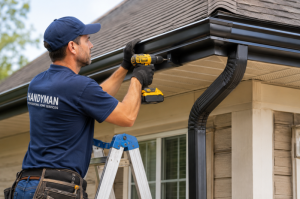
The Most Common Gutter Problem Is Overflow
Overflow is usually the symptom rather than the underlying problem.
On many jobs, I find that the gutter itself looks relatively clean from the ground. Yet during heavy rain, water spills over one particular section or corner.
There are a few clues I look for:
- The gutter appears clean but water is still overflowing.
- The overflow occurs at one specific low spot or corner.
- Very little water is coming out of the bottom of the downspout.
- The downspout makes little or no sound during heavy rain.
- There is staining on the fascia, brick, or siding below the overflow.
- The gutter has started to sag near the problem area.
- A hanger or fastener has become loose.
When I open the downspout or elbow, I often find a compacted plug made up of wet leaves, roof grit, seeds and small twigs.
Once that material gets wet, it can become surprisingly dense. Water cannot get through quickly enough, so it backs up into the gutter and eventually spills over the edge.
Why Cleaning the Gutter Does Not Always Fix the Problem
One of the biggest mistakes I see homeowners make is cleaning only the visible gutter channel.
They remove the leaves they can see, look up at the clean trough and assume the job is done.
But I always look at the entire drainage path.
The downspout outlet can be blocked right where the gutter connects to it. An elbow can be packed with debris. A lower section can be partially obstructed. In some homes, the downspout connects to an underground drainage system that can also become blocked.
That means a gutter can look perfectly clean and still overflow.
My practical rule is simple: if the gutter is clean but still overflowing, stop looking only at the gutter and follow the water.
What I Usually Find During a Gutter Overflow Inspection
When I investigate an overflow complaint, I don’t just scoop out the gutter and leave.
I work through the drainage system to find where the water is being restricted.
Start at the roof
I look at roof valleys, additions and other areas where a large amount of water may be concentrated into a relatively small section of gutter.
This matters particularly during a short, intense Toronto summer storm. A gutter may handle ordinary rainfall without a problem but overflow when a sudden downpour sends a large volume of water toward one corner.
Check the gutter slope
A gutter needs to drain toward its outlet.
If a section has sagged, water can sit in the trough instead of moving efficiently toward the downspout. A blockage isn’t always the only issue.
Sometimes I find a combination of problems: a partially blocked downspout and a sagging gutter.
That combination can make a relatively small drainage problem much worse.
Inspect the downspout opening and elbows
This is one of the most important parts of the inspection.
Leaves and roof grit can collect at the downspout entrance or become packed inside an elbow. From the ground, everything can look normal.
I want to know whether water can actually travel freely through the downspout.
Follow the water to the discharge point
The inspection shouldn’t end at the bottom of the downspout.
I also check the extension, splash block or underground connection and make sure water is actually being directed away from the house.
A blocked underground connection can create drainage problems even when the gutter and downspout above it are relatively clear.
A Typical Downtown Toronto Gutter Problem
A situation I would use as a representative example from this type of work is a narrow two-storey downtown Toronto semi-detached home with a small rear addition and a mature tree close to the roofline.
The homeowner’s complaint was straightforward: water was pouring over one corner of the eavestrough whenever it rained. They had already removed the visible leaves from the gutter, but the overflow continued. There was also dark staining on the brick below, and they were understandably concerned about water getting close to the basement wall.
The main gutter channel wasn’t heavily blocked.
The problem was at the downspout. The outlet and first elbow were packed with wet leaves, roof grit and small twigs. The gutter also had a slight sag near that corner, which allowed water to settle instead of flowing consistently toward the outlet.
The appropriate repair in that situation isn’t automatically replacing the entire gutter system.
The drainage path needs to be cleared and tested first.
The repair would involve removing the blockage, flushing the downspout from the appropriate access points, securing the loose gutter section and correcting the slope so water can consistently reach the outlet.
The secondary issues can also tell you how long the problem has been occurring. In this type of situation, I would look for staining, loose fasteners, damp debris and any deterioration around the fascia.
The important lesson for homeowners is that an overflowing gutter doesn’t automatically mean the gutter needs to be replaced.
Sometimes the problem is a blockage and a relatively small alignment or fastening issue.
Why Downtown Toronto Homes Can Be Particularly Challenging
Gutter problems don’t happen in exactly the same way on every property.
Downtown Toronto has a combination of conditions that can make gutter drainage more complicated.
Mature trees create constant debris
Many older Toronto neighbourhoods have mature maples, oaks and other large trees close to houses.
Leaves are the obvious problem, but I also find seeds, small branches, roof grit and decomposed organic material in gutter systems.
A home underneath heavy tree cover may need more frequent attention than a property in an open area.
More importantly, homeowners should not assume that removing the leaves they can see is enough.
I pay particular attention to the downspout opening, elbows, lower sections and discharge point on properties surrounded by trees.
Heavy summer rain can expose weaknesses
A gutter system may appear to work perfectly during normal rainfall.
Then a sudden summer downpour arrives and water starts pouring over the edge.
I pay particular attention to roof valleys, long gutter runs, inside corners and additions because these areas can concentrate a large volume of water into a relatively small section.
If the gutter is clean and properly sloped but still consistently overflows during heavy rain, I start looking at the drainage capacity and whether the downspout is partially blocked, undersized or receiving water from more roof area than the system was designed to handle.
Older homes often have modified drainage systems
Downtown Toronto has plenty of older semis, detached homes and narrow-lot properties.
Over the years, gutters and downspouts may have been modified as additions were built or repairs were made. I can encounter short gutter sections, mismatched downspouts, improvised elbows and drainage routes that aren’t particularly well suited to the property.
That’s why I don’t like inspecting only the section where the homeowner sees water.
I want to understand the entire route.
Freeze-thaw weather can make existing problems worse
Toronto winters can be hard on a gutter system that already has drainage problems.
If water is sitting in a gutter or downspout, repeated freezing and thawing can put additional stress on seams, fasteners, hangers and other components.
A gutter that is already slightly sagging can become worse over time.
That’s one reason I prefer addressing drainage problems before winter rather than simply removing ice after the fact.
If I encounter an ice-related problem, I want to understand why the water is accumulating in the first place.
The Secondary Damage an Overflow Can Cause
An overflowing gutter isn’t always just a nuisance.
If it happens repeatedly, the excess water and weight can contribute to other problems.
I look for:
- Loose or pulled-out gutter hangers
- Sagging sections
- Staining on brick, siding or fascia
- Deteriorated sealant or open seams
- Soft or damaged fascia
- Water collecting around the foundation
- Soil erosion below the discharge point
- Damp debris sitting around the gutter edge
One problem can create another.
For example, a partially blocked downspout can cause water to sit in the gutter. The additional weight can contribute to sagging. The sag then creates an even poorer drainage path, making the original overflow problem worse.
That’s why I don’t treat overflow as simply a cleaning issue.
What Homeowners Can Check Before Calling a Handyman
There are a few basic observations a homeowner can make safely from the ground.
Watch the gutter during rain
If possible, observe where the water is overflowing.
Is it beside the downspout? At a corner? At a low spot? Or along the entire gutter run?
That information can be extremely useful.
Check the downspout outlet
During rainfall, look at how much water is coming out.
A strong flow suggests that water is making it through the downspout. A weak trickle, especially when the gutter above is overflowing, can indicate a partial blockage.
Look for standing water
After the rain stops, check whether water remains in one section of the gutter.
Standing water can indicate poor slope or a sagging section.
Look for visible separation
From the ground, check for obvious gaps, loose sections, cracked elbows or a downspout that has separated from its connection.
Also look for signs that the gutter has pulled away from the fascia.
Check where the water ends up
Make sure the downspout extension or splash block isn’t blocked and that water is being directed away from the foundation.
I would not recommend climbing onto a steep or wet roof simply to investigate a gutter problem. If the downspout is buried, the fascia appears soft, or the gutter is badly sagging, a proper inspection is safer and more useful.
When a Gutter Needs More Than Cleaning
Not every overflow requires replacement.
At the same time, cleaning isn’t always enough.
If the system is clean but has badly damaged sections, persistent poor slope, inadequate drainage capacity, failed connections or deteriorated supporting materials, repair or replacement may be justified.
The important thing is to identify the actual failure first.
I would be cautious about recommendations such as:
- Replacing an entire gutter system because one downspout is blocked
- Installing gutter guards before fixing poor slope or loose hangers
- Replacing sound gutters when the actual problem is an obstructed underground drain
- Adding downspouts without establishing that the existing drainage capacity is inadequate
- Replacing fascia or soffit without showing the homeowner where deterioration exists
- Repeatedly applying sealant to a mechanically damaged or misaligned joint
- Installing heated cables as the first answer to every winter gutter problem
None of these solutions is automatically wrong. The issue is whether the contractor can connect the recommendation to a specific problem they actually found.
How to Avoid Paying for Unnecessary Gutter Work
My no-BS advice to homeowners is straightforward:
Don’t approve replacement work until someone has traced the entire drainage path and shown you why cleaning or a smaller repair won’t solve the problem.
A good gutter quote should explain the failure, not simply say “replace eavestrough.”
Ask what was actually inspected
I would want the contractor to inspect:
- The gutter channel and low spots
- Downspout openings and elbows
- The full accessible downspout
- Gutter pitch
- Hangers and fasteners
- Open seams and connections
- Fascia condition
- Roof valleys and additions
- Downspout extensions or underground connections
- The final discharge point
Ask for an itemized quote
I prefer a written quote that clearly explains what is being done.
It should identify the sections being cleaned, repaired or replaced and distinguish necessary work from optional upgrades.
I would also want to see materials, labour, disposal, taxes, warranty information and exclusions clearly explained.
A single round number makes it difficult for a homeowner to compare two quotes fairly.
One contractor might include downspout flushing, disposal and minor repairs while another might be quoting only for replacement materials and installation.
Gutter Quote Red Flags I Would Watch For
I would have questions if a contractor:
- Gives a replacement quote without testing the downspouts
- Cannot identify where the overflow is occurring
- Uses vague phrases like “drainage issue” without explaining the cause
- Pushes gutter guards as a universal solution
- Gives only one large number without line items
- Claims the work is urgent without showing active damage
- Pressures you to sign immediately
- Demands an unusually large cash deposit
- Refuses to provide insurance information or a written warranty
- Says the quoted price is available only “today”
The biggest warning sign, in my opinion, is when someone recommends an expensive solution before properly diagnosing the problem.
My Rule for Diagnosing Gutter Problems
If I could give a Toronto homeowner just one piece of advice, it would be this:
Clean and test the whole drainage path before replacing anything.
Follow the water from the roof edge, through the gutter, into the downspout, through the lower connection and all the way to the final discharge point.
If the system is clean, properly sloped, securely attached and still cannot handle the water, then replacement or redesign may make sense.
But if nobody has checked those basics, you’re being asked to pay for a solution before the problem has actually been diagnosed.
The Bottom Line
The most common gutter problem I encounter around Downtown Toronto is overflow caused by a blockage, particularly around the downspout entrance or inside the downspout.
But the blockage is often only part of the story.
A partially blocked downspout can lead to standing water, extra weight, sagging, loose hangers and eventually more serious drainage problems.
That’s why I don’t look at an overflowing gutter and automatically assume the gutter itself needs to be replaced.
I look at the entire drainage system.
Toronto’s mature trees, heavy summer storms, older homes, narrow lots and freeze-thaw winters all make that full-system approach even more important.
For homeowners, the takeaway is simple: don’t just ask whether your gutters are clean. Ask whether the entire drainage path is clear, properly sloped, securely attached and actually getting water away from your home.