
30July 2026
If you’re mounting a TV in a Toronto condo, townhouse, or detached home, the single most common question I get is: “How high should it go?” The short answer: it depends on your room, your furniture, and how you actually watch TV. The long answer, the one that saves you from neck strain and regret, is what this guide is all about.
As a handyman who’s mounted hundreds of TVs across downtown Toronto, Mississauga, and Hamilton, I’ve learned that the “perfect” height isn’t a number you find on Google. It’s the height that feels natural after two hours on the couch. In this post, I’ll share my rule of thumb, real client stories, common mistakes I fix, and the myths I wish everyone would stop believing.
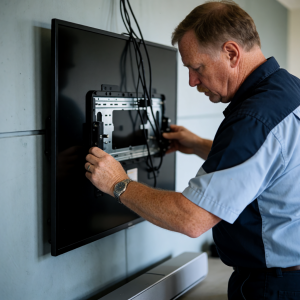
My Go-To Rule of Thumb for TV Mounting Height
My general rule is simple: mount the TV so the center of the screen is roughly at seated eye level from your main viewing position. In most living rooms, that works out to the center of the TV being about 42–48 inches from the floor, depending on your sofa height and TV size.
But here’s the catch: that’s a starting point, not a final answer. Over the years, I’ve seen this “rule” evolve, especially as TVs have gotten bigger and Toronto homes have changed.
Fifteen years ago, 40–55 inch TVs were standard, and people mounted them above media consoles with traditional layouts. Today, I’m regularly installing 65-, 75-, and even 85-inch screens in downtown condos where space is tight and fireplaces are less common. With larger TVs, I focus less on a fixed measurement and more on keeping the lower third of the screen within your natural line of sight while seated.
In newer condos, I’m mounting more TVs directly on feature walls at comfortable viewing heights rather than high above mantels. And when clients ask me to mount over a fireplace, I usually recommend a tilting mount to improve the angle. The best TV height isn’t a single number, it’s the height that feels right for your room and your habits.
Real Toronto Case Studies: When “Standard” Height Didn’t Work
Case Study #1: Downtown Condo with a Low Sofa
A client in a newer downtown Toronto condo bought a 75-inch TV and initially wanted it mounted using standard online measurements. Following the “center at eye level” approach would have placed the TV a bit higher than usual because of the screen size.
When I visited, I noticed their sectional sofa sat unusually low to the ground, and they primarily used the room for movie nights. After taking viewing measurements from the actual seating position, it became clear that the standard height would have forced them to look slightly upward during long viewing sessions.
Instead, I lowered the mount by several inches so the lower third of the screen lined up more naturally with their seated sightline. The result was a setup that felt more immersive and comfortable, especially for watching movies in the evening. A few weeks later, the client mentioned that friends often commented on how “easy” the TV felt to watch, even though they couldn’t pinpoint why.
Case Study #2: Townhouse with a Fireplace Feature Wall
Another client in a downtown Toronto townhouse wanted a 65-inch TV mounted above a fireplace because it was the room’s focal point and there was no practical wall space elsewhere.
The challenge was that the fireplace mantel already pushed the TV well above the height I would normally recommend. Mounting it in the standard position above the mantel would have placed the center of the screen significantly higher than seated eye level, creating potential neck strain during longer viewing sessions.
Rather than simply mounting it as high as possible, I installed a full-motion tilting mount and positioned the TV as low above the mantel as safety and clearance allowed. Once installed, we adjusted the tilt angle downward toward the main seating area.
The outcome was a good compromise between aesthetics and comfort. The TV still looked balanced within the room’s design, but the viewing angle felt much more natural than a fixed mount at the same height. The client was particularly happy because they got the clean fireplace-centered look they wanted without sacrificing usability.
These jobs are good reminders that viewing habits matter just as much as measurements. Someone who mainly watches sports in a bright room from multiple seats may prefer a slightly higher placement for broader visibility, while dedicated movie watchers typically appreciate a lower, more cinema-like viewing angle. The best installations happen when the TV height is tailored to how the room is actually used, not just to a generic formula.
Common TV Mounting Mistakes I See (and How I Fix Them)
After years of installations across downtown Toronto, here are the most frequent mistakes I see, and how I correct them:
-
Mounting based on the wall, not the viewing position. Homeowners often center the TV on a large empty wall because it looks visually balanced, but once they sit down, they realize they’re looking up. My fix: always evaluate the seating arrangement first. The TV should work for the people watching it, not just for the wall it’s mounted on.
-
Mounting too high above a fireplace. This is probably the number one correction call I get. Many homeowners prioritize aesthetics and don’t realize how uncomfortable a high-mounted TV can be during a two-hour movie or a weekend of sports. When relocation isn’t practical, my usual fix is installing a quality tilting or full-motion mount to improve the viewing angle and reduce neck strain.
-
Relying on generic online height charts. A chart might suggest a certain mounting height for a 65-inch TV, but it doesn’t know whether you have a low sectional, a recliner setup, or bar-height seating behind the sofa. My advice: sit in your primary viewing position and measure from your eyes, then use that as the starting point.
-
Treating large TVs like small ones. A mistake that’s become more common with 75- and 85-inch screens is applying the same logic as for smaller TVs. I’ve seen installations where the center of the screen was technically at the “correct” height, but the bottom edge ended up far too low or the top edge dominated the field of view. For larger screens, I focus on overall viewing comfort and sightlines rather than obsessing over a single measurement.
-
Failing to account for furniture before mounting. Sometimes a homeowner buys a media console after the TV is already installed, only to discover there’s barely any clearance between the console and the bottom of the screen. Other times, a soundbar blocks part of the TV or creates an awkward gap. When I’m planning a mount, I always consider the TV, soundbar, console, and future upgrades together so everything works as one setup.
When I’m called in to fix a problematic installation, the solution is usually straightforward: evaluate the room from the main seating position, determine how the space is actually used, and adjust the height accordingly. In many cases, moving the TV just a few inches up or down can make a dramatic difference in comfort.
Pro Tips Beyond Height: 3 Things That Dramatically Improve Your TV Setup
After years of mounting TVs in downtown Toronto condos, townhomes, and houses, I’ve found that a few simple decisions can make a bigger difference to the viewing experience than the exact mounting height itself.
Choose the Right Mount, Not Just the Cheapest One
A lot of homeowners focus on the TV and treat the mount as an afterthought. In reality, the right mount can completely change how comfortable and flexible the setup feels. For most living rooms, I recommend a quality tilting mount, especially if there’s any chance the TV will end up slightly higher than ideal. If the room has multiple seating areas or an open-concept layout, a full-motion mount is often worth the investment because it allows the screen to be adjusted for different viewing positions.
I’ve seen clients spend thousands on a premium TV and then install it on a basic fixed mount that limits their options. A better mount often delivers more day-to-day value than many of the TV upgrades people pay extra for.
Don’t Ignore Cable Management
Nothing ruins the look of a professionally mounted TV faster than a bundle of visible cables hanging below it. Clean cable management not only improves appearance but also makes the entire room feel more organized and intentional.
Whenever possible, I recommend concealing cables inside the wall or using a paintable cable raceway that blends into the wall surface. It’s a relatively small detail, but it’s one of the first things people notice when they walk into a room. A clean installation can make even a modest TV setup look high-end.
Think About Sound and Lighting from Day One
Many homeowners spend a lot of time choosing a TV and very little time considering what they’ll hear and see around it. If you’re adding a soundbar, plan its placement before the TV is mounted so the spacing looks balanced and the TV doesn’t need to be repositioned later.
Lighting is equally important. In downtown Toronto condos with large windows, glare can be a bigger problem than TV quality. I often suggest avoiding direct reflections from windows and adding soft ambient lighting behind or around the viewing area. Reducing glare and eye strain can have a surprisingly large impact on how enjoyable the TV feels, especially during evening movie sessions.
If I had to summarize my advice in one sentence, it would be this: focus on the entire viewing experience, not just the screen. The best setups combine comfortable viewing height, a quality mount, clean cable management, good sound, and controlled lighting. When all of those elements work together, even a mid-range TV can feel like a premium home-theater experience.
The Biggest TV Mounting Myth I Want to Debunk
One TV-mounting myth I’d love to debunk is: “The center of the TV must always be exactly at eye level.”
People often read this online and assume it’s a hard rule that applies to every room, every TV size, and every viewing setup. In reality, it’s a useful starting point, not a law.
When clients ask about the “correct” height, I explain that eye level is a guideline designed to promote comfortable viewing, but there are many factors that influence the final placement. The size of the TV, the distance from the seating area, the height of the sofa, whether people recline while watching, and the overall room layout all matter.
For example, with today’s larger 75- and 85-inch TVs, mounting the exact center at seated eye level can sometimes place the screen lower than what feels visually balanced in the room. On the other hand, mounting a large TV significantly higher because it’s a large screen can create neck strain and an uncomfortable viewing angle. The answer is usually somewhere in between.
Another misconception tied to this myth is that any TV mounted above eye level is automatically wrong. That’s simply not true. In many downtown Toronto homes and condos, architectural features, fireplaces, windows, or furniture layouts create constraints. A slightly higher mount can work perfectly well when paired with the right viewing distance and, in some cases, a tilting mount.
What I tell clients is this: don’t chase a measurement, chase comfort. The goal isn’t to hit a magic number on a tape measure. The goal is to create a setup where you can sit down for a movie, a hockey game, or a binge-watching session and forget about the TV’s position entirely.
After years of installations across downtown Toronto, I’ve found that the best TV height is rarely determined by a formula alone. It’s determined by how the screen feels from the seat where you’ll spend hundreds of hours watching it. If you’re comfortable after two hours on the couch, you’ve probably got the height right.
Final Thoughts: Your TV, Your Rules
Mounting a TV is one of those projects that looks simple on paper but has a lot of nuance in practice. Whether you’re in a Liberty Village condo, a Hamilton townhouse, or a Mississauga detached home, the principles are the same: start with seated eye level, adjust for your room and habits, and don’t be afraid to break the “rules” if it means better comfort.
If you’re in the Greater Toronto Area and want a TV mounted right the first time, no guesswork, no neck strain, no regrets, reach out. I’ve helped hundreds of homeowners get it right, and I’d be happy to do the same for you.